Music for Flesh II
Keywords
Concert, biophysical music, new interfaces, bioacoustics, physiological computing
Format
Solo concert for one performer and biophysical sound.
Duration
10 minutes
Media
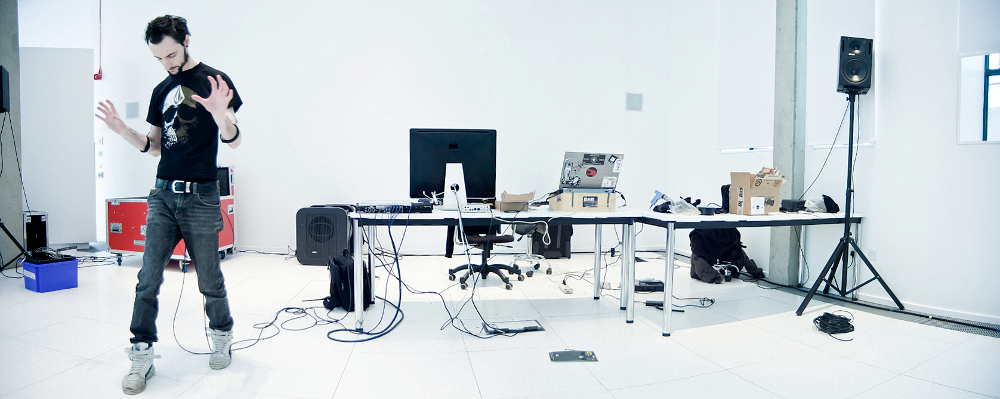
Custom-built XTH Sense bioacoustic sensors, computer, loudspeakers, subwoofers, yellow par can spotlights
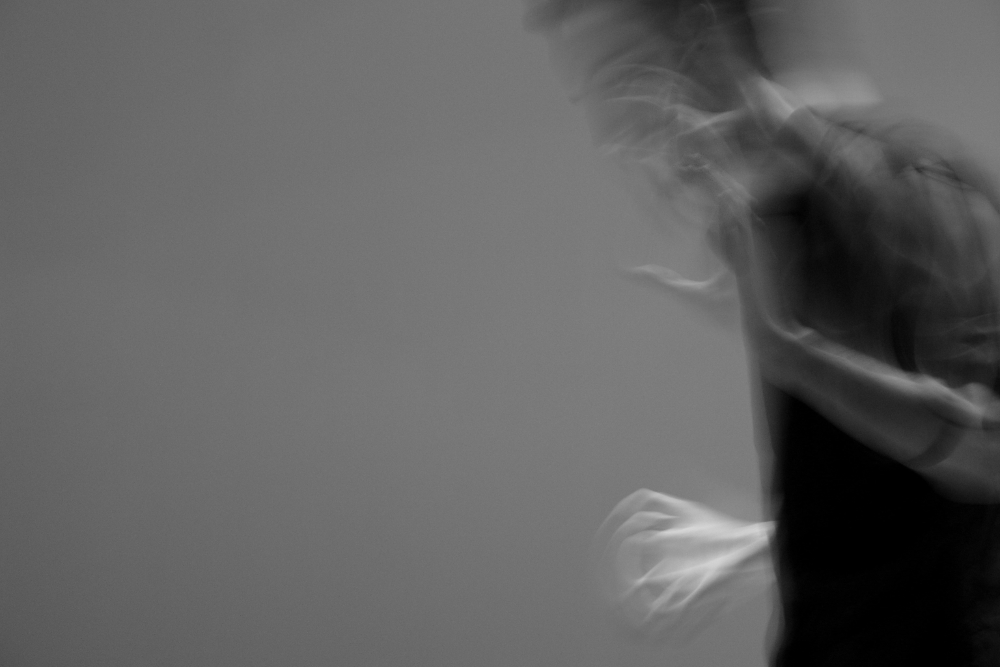
World Premiere
15 March 2011, Inspace, Edinburgh
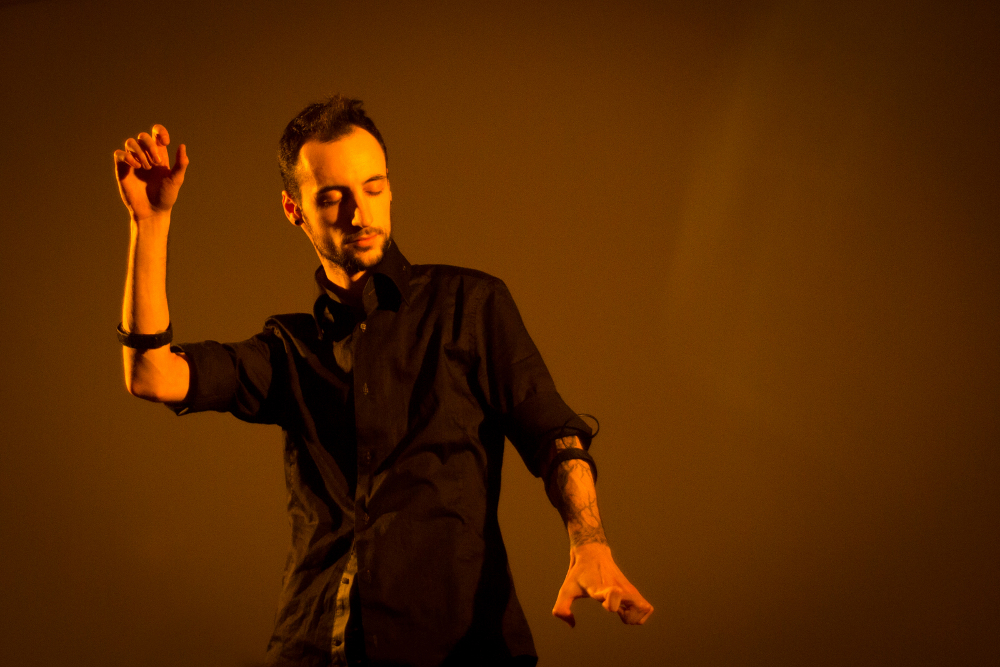
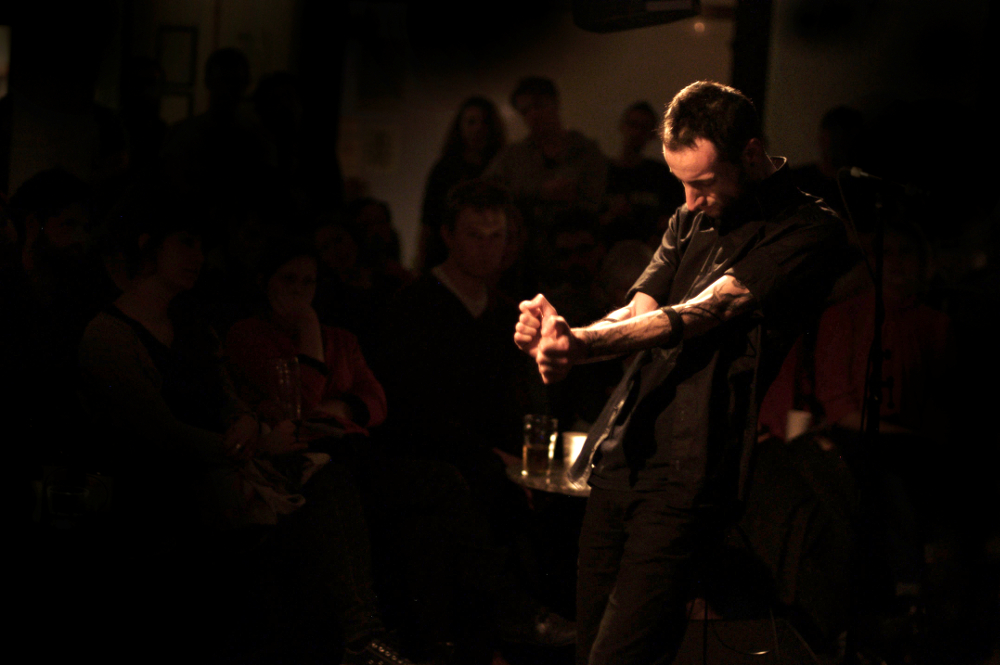
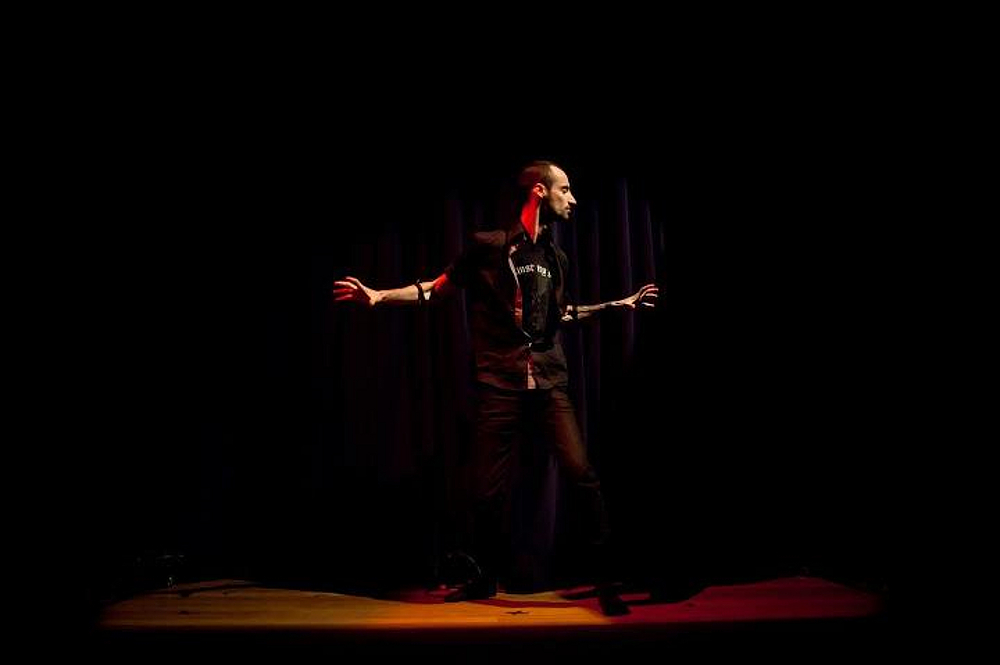
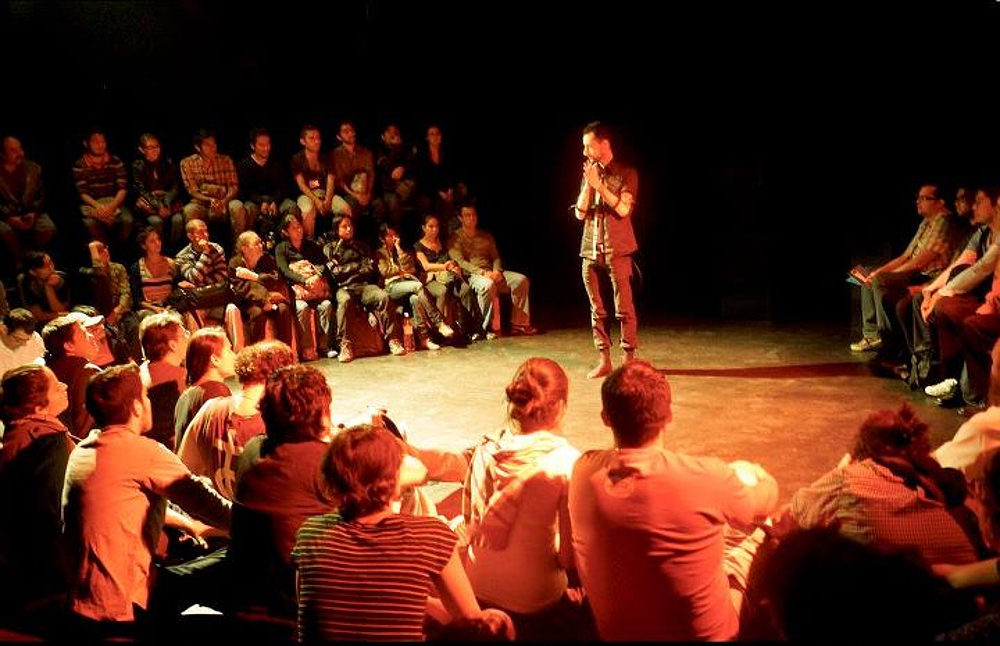
Music for Flesh II is a an interactive sound art performance for enhanced body. The piece is performed in a concert setting with a circular array of subwoofers and loudspeakers. The piece creates a seamless mediation between human bioacoustics and algorithmic composition using the XTH Sense, a biophysical musical instrument created by the author.
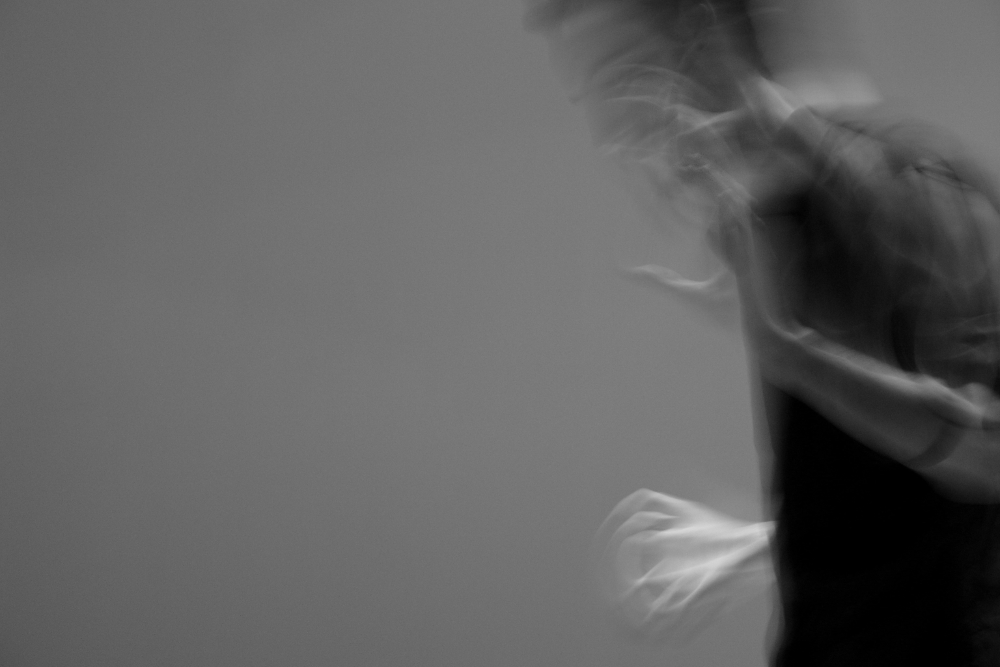
A performer stands in a dark room, hit with two spotlights. When the visitors enter the room the performance begins. As the performer moves, muscle movements and blood flow produce subcutaneous mechanical oscillations, which are nothing but low frequency sound waves. Two chip microphone sensors capture the sonic matter created by the performer limbs and send it to a computer.
The computer develops an understanding of the performer’s kinetic behaviour by listening to the friction of his flesh. Specific gesture, force levels and patterns are identified in real time by the computer; then, according to this information, the computer manipulates algorithmically the sound of the performer’s flesh and diffuses it through an octophonic sound system.
The computer learns about and interact with the performance: strong and wide movements repeated for longer than 30 seconds prompt the computer to increase the sound loudness and density of the processed output; a repeated excitement of the left bicep causes a rich vibrato; an abrupt contraction of the right forearm moves the sound across the right side of the sonic field.
By enabling a computer to sense and interact with the muscular sonic potential of human tissues, the work approaches the biological body as a means for computational artistry. The neural and biological signals that drive the performer’s actions become analogous expressive matter, for they emerge as a tangible haunting soundscape. The border between physical and virtual body is blurred and dissolved; by harvesting pure kinetic energy from corporeal sounds, incarnated gesture and concrete vibrations, the piece actualizes before the audience eyes a visceral and cognitively challenging territory.
The work defines a temporary cognitive time-zone in which the physical space of the performance is augmented, stretched, enlightened, obscured, dominated by a real time reconstruction of the human body primal expressiveness. Body is no longer silent, and the embodied interaction which was so far kept mute, now acquires a new textural layer, a tangible and profound level of interpretation and representation which can be at the same time intimately experienced by the performer, and audibly and visually externalized in order to embrace the audience.
Credits
Concept, artistic direction, staging, choreography and performance: Marco Donnarumma
Music, interaction programming, physiological computing software and hardware: Marco Donnarumma
Sound engineering during production: Kevin Hay, Brendan Doyle
Light design: Brendan Doyle
Artwork’s description text: Marco Donnarumma
Live photography: Mark Daniels, Chris Scott, Dimitris Patrikios, Parag K Mital, Fabiola Cordero
Technical support: Edinburgh Hacklab, Dorkbot ALBA
Video trailer: Marco Donnarumma
An artwork and production by Marco Donnarumma. Supported by Sound Lab at the University of Edinburgh and Inspace. With early touring support by Creative Scotland.
Awards
2012, Georgia Tech University
1st Prize Guthman Musical Instrument Design Competition
Next shows
-
28 October 2026
Ominous + Music for Flesh II @ Tangible Music Club
Tangible Music Club | Stadtwerkstatt, Linz, AT
Past Shows
emitter micro #6
Peterburg Art Space (PAS), Berlin, DE, 2023
Open Sounds
Westdeutscher Rundfunk Radio 3, DE, 2021
Resonans: Unfolding Marco Donnarumma
KU.BE, Copenhagen, DK, 2018
Music Lab: Biophysical Music
Musicology Department, University of Oslo, NO, 2017
Holzmund #5
Urban Spree, Berlin, 2017
Institute of Electronic Music and Acoustics IEM
performed by Intrasonic Duo, Graz, 2017
transmediale Vorspiel Hypernatural Sounds
SomoS Gallery, Berlin, 2016
Scope Session Live
Spektrum, Berlin, 2015
NEMO Biennale/IRCAM Live
La Gaîté lyrique, Paris, 2015
Maintenant Festival
Hotel Pasteur, Rennes, 2015
Embodied Sound
University of East London, London, 2015
Apiary Session
Apiary Studios, London, 2015
MusicMakers Hacklab
Laboratorio Arte Alameda, Mexico City, 2015
CTM Festival
Kunsthaus Bethanien, Berlin, 2015
Hyphen Hub Salon
Red Door Space, New York City, 2014
Spectrum NYC
Dark Circuits Festival, New York City, 2014
Olematute kylade projekt / Project for Non-existent Villages
Tartu, EE, 2014
Sónar+D / Opening Music Hack Day
Universidad Pompeu Fabra, Barcelona, ES, 2014
Arte Performatica y Tecnologia, ZonAutonoma
Puebla, MX, 2014
2° Encuentro Internacional de Arte Sonoro
Universidad Nacional Autonoma de Mexico, Mexico City, MX, 2014
STEIM Concert of Bodies
Studio for Electro Instrumental Music, Amsterdam, NL, 2014
Experimental Intermedia
hosted by Phil Niblock, New York City, NY, US, 2014
ICT & Art Connect
Watermans Art Centre, London, UK, 2014
TransitioMX Biomediaciones
CENART, Foro de las Artes, Mexico City, MX, 2013
DA Fest
National Academy of Arts, Sofia, BG, 2013
Kontejner
Sound Art Incubator, Mocvara Gallery, Zagreb, HR, 2013
STEIM Summer Party
Studio for Electro Instrumental Music, Amsterdam, NL, 2013
Falanster
Wroclaw, 2013
Centre for Contemporary Art Ujazdowski Castle
Warsaw, 2013
Art&Science Meeting
Łaźnia Center for Contemporary Art, Gdansk, 2013
SARC Lunchtime Concert
Sonic Arts Research Center, Belfast, NIR, 2012
Robots and Avatars/KIBLA Festival
KID Kibla, Maribor, SL, 2012
ISEA International Symposium on Electronic Arts
Albuquerque, New Mexico, US, 2012
Robots and Avatars UK Selection
Europe House, London, UK, 2012
Live Interfaces: Performance, Art, Music
ICSRiM, University of Leeds, UK, 2012
Turing Festival/Music Hack Day Scotland
Summerhall, Edinburgh, UK, 2012
FILE Hypersonica
SESC-SP, Sao Paulo, BR, 2012
Body/Controlled: BioInterfacing
LEAP, Berlin, DE, 2012
USA Tour: NIME Conference
Michigan University, Ann Arbor, MI, 2012
USA Tour: Share.dj
Gowanus Institute Space, New York, NY, 2012
USA Tour: Harvestworks
New York, NY, 2012
USA Tour: American University
Washington, DC, 2012
USA Tour: They, Who Sound
Avant Garden, Houston, TX, 2012
Liveness, Gesture, Prosthesis, Metaphor
CENART, Centro Nacional de las Artes, Mexico City, MX, 2012
INTER/actions
Bangor University, Bangor, UK, 2012
Dialogues, Edinburgh Science Festival
Inspace, Edinburgh, UK, 2012
BEAM Night
Cafe OTO, London, 2012
Sonorities Festival
SARC, Belfast, IRL, 2012
Finals Guthman New Musical Instrument Competition
First Prize, Georgia Tech, Atlanta, US, 2012
NetaudioLX Festival
Cinema S. Jorge, Lisbon, PT, 2012
Dimensions in Sound
CultureLab Newcastle, UK, 2011
Piksel Festival
Studio USF, Bergen, NO, 2011
7° Simposio UNAM
ENAP/UNAM, Mexico City, MX 2011
Noise=Noise
nnnnn, London, UK, 2011
4th Pure Data Convention
Bauhaus Universitat, Weimar, DE, 2011
Kernel Festival
Desio, IT, 2011
BEAM Festival
Uxbridge University, London, UK, 2011
Linux Audio Conference
Aula Maxima, NUI Maynooth, NIR, 2011
eXperimontag
Madame Claude, Berlin, DE, 2011
Non-Bio Boom | Xth Sense
Inspace (School of Informatics and New Media Scotland), Edinburgh, UK, 2011
Grind Sight Open Eye
The Spectacular Café Diablo, Edinburgh, UK, 2011
Pure Data Mini Conference
Trinity College, Dublin, NIR, 2011
The University of Edinburgh
Alison House, Edinburgh, UK, 2011
Selected Bibliography
-
Mon Corp est mon Instrument,
ARTE Tracks, 4 April 2014
-
The Sonic Body: Interview with Marco Donnarumma,
Silvia Bertolotti, Digicult, 14 June 2012